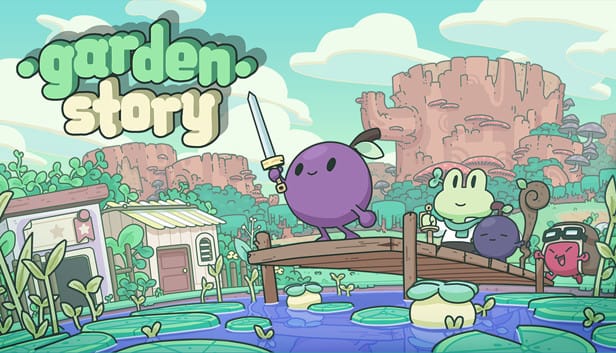
Garden Story is game that released on August 11th 2021 and was developed by Picogram and published by Rose City Games. While this game may be over a year old, it was one that I had my eye on for quite some time during it’s development . The gameplay is a simple hack and slash adventure with lite farming and town management sim elements. While the gameplay intrigued me, what initially attracted me to the game was its colorful and cute art style that alluded to a cozy land of possibilities.
A guardian is born
Garden Story begins with Concord the grape, the last greenling to be born from the Grove and newly appointed guardian. Your role is simple, protect the various towns across the Grove from the threat of Rot, a slime-like set of creatures that have tainted the world that Concord and their friends reside in. As a guardian, Concord will not only be tasked with pushing back the Rot through force but will also be required to help the other inhabitants as well. This results in Garden Story not just focusing on combat but resource management too. Some of the other greenlings you encounter like Fuji the apple or Maraschino the cherry, will need various resources that can only be obtained by breaking down things like tree stumps or glass bottles out in the world.
This duality of combat and resource management allows the game to be broken down into two different parts.
1. Collect resources by breaking things stumps, rocks, or even tombstones later. Then using these collected resources to complete quests, repair parts of a town, or even upgrade items.
2. Fight the Rot to protect those that live in the Grove and explore dungeons to fight more challenging enemies while discovering rare items.
The gameplay loop is very simple but it’s the way that you go about collecting items and fighting back that makes Garden Story stand out early on.

Multipurpose Tools
As you progress through the game you’ll find out that certain resources can only be gathered or enemies can only be defeated when Concord has the right tool equipped. The arsenal that Concord has at their disposal can range from an umbrella that allows multiple strikes in a row or a fishing rod that allows you to fight from a distance. While the variety of fighting styles is something that allows Garden Story to be played the way you want, it should also be noted that the player is able to swap between tools as needed via a quick slot bar.
The ability to switch to any tool you’ve assigned to a quick slot definitely comes in handy as you progress but not because of combat. You are often switching between different tools so that you can collect more resource types as they become available to gather throughout the adventure. While there are new enemy types in each area, I mostly found myself only switching from my preferred weapon when an enemy had a unique gimmick that called for a different weapon type. Once an enemy was hit with the required weapon type, you can follow up with attacks from whichever weapon you feel best suits your style.
Weapon type is not the only choice choose that influences your combat techniques. Concord has traits such as Health, Stamina, Luck, Speed, and many more that affect the way Concord plays. The most noticeable stats to me were Health and Stamina, as they determine how many hits you can take and how many times you can dash, roll, or swing your weapon. Luckily, these stats are not set in stone and can be customized by equipping something called Memories. Memories are earned by completing various challenges such as getting hit a certain number of times or hitting enemies with a specific amount of attacks. The stat customization comes from each Memory providing a buff or debuff to certain stats.
Not only do you get to customize the way you play but you can change how Concord looks as well. There are a variety of hats and backpacks that can be purchased. No matter what task you’re trying to tackle, you always look the part.

Accepting Nature
At a glance, the story seems to be a by-the-numbers narrative of a fresh and green protagonist being chosen to save the land they reside in. Initially, the story of Garden Story appears to be no different. Concord faces a lot of doubt and distrust from other greenlings and residents of the Grove and only after they have proven themselves do they gain more admiration from others. While I won’t spoil the ending of the story I was surprised for it to take a deeper turn about the nature of life and acceptance of what that means as we grow old.
The acceptance of the nature of life is the grand message overall but the smaller story beats reside around Concord discovering what happened to past Guardians, helping the residents in each of the four towns, and finding out what horrors can be found in the dungeons below each town.
The dungeons are comprised of puzzles that require the player to utilize a new tool, gimmick, or even weapon to progress. None of the puzzles stand out or dungeons stand out but the real challenge comes from the boss at the end of each dungeon. These boss fights allow you to progress to the next part of the game and will yield additional upgrades and resources that are only available in that dungeon. Each boss is unique and feels the right level of challenge.
Time is saved, but also wasted
The world of the Grove is not one that is incredibly large when compared to other modern-day games but the developers, Picogram, recognized that adding fast travel was a necessity as you reach the end of the game. This is done via a teleport system and it appearing at the end of the story makes total sense when some minor backtracking is involved.
Unlike the fast travel system, I felt that the farming simulation part of the game was introduced far later than it should have been. Early on in the game, I noticed that I had the option to purchase seeds from shops but only if I had a seed pouch. At this point, the seeds seemed like they would only be used to grow additional resources and that farming was a feature that was entirely optional. However, when I arrived in the third town I learned that the only way for me to move forward was to spend some time farming. This meant that I had to spend three days in the game waiting for seeds to grow into harvestable plants to continue. I was also unable to leave to other towns and explore the rest of the world. This meant I was confined to one of the towns with only sidequests and daily tasks to kill time. I could only move on to the next day when the clock entered the evening.
Luckily, I did discover that the game does have a way to make time pass faster. Time will move quicker when Concord is sitting on a bench. Even though the game has a built-in solution for making time pass faster, I feel that this issue could have been avoided if the ability to farm was introduced much earlier on in Garden Story. Introducing farming earlier would allow the player to build up resources passively so that by the time those resources are needed, the player is ready and progress doesn’t feel like it comes to a slow down or a halt.

You’re in the Endgame Now
Once you have completed your quest to save the Grove, the game doesn’t stop there. Concord is still able to collect resources and complete both quests and daily tasks. While there is no major additional unlocks or story resource to keep playing Garden Story once the credits roll, it is nice that the game allows the player to stay on top of their guardian duties if they so choose. Additional clothing options are available if players complete collection lists but this is something for the completionists of the world to strive for or for people who just love hanging out in the Grove.

Final Thoughts
Overall I liked Garden Story despite some minor flaws and definitely recommend it if you looking for a farming sim with more of an adventure. I played this game on Xbox GamePass and recommend picking it up there if you’re on the fence. It’s a game that can be completed in about a week. I’m very interested to see if Picogram puts out a sequel or any other cozy adventures in the future